Why One Thermostat Was Never Enough for a Two-Story House
A house is not one temperature. One thermostat has only ever been able to pretend it is.
August 27, 2026 · 4 min read
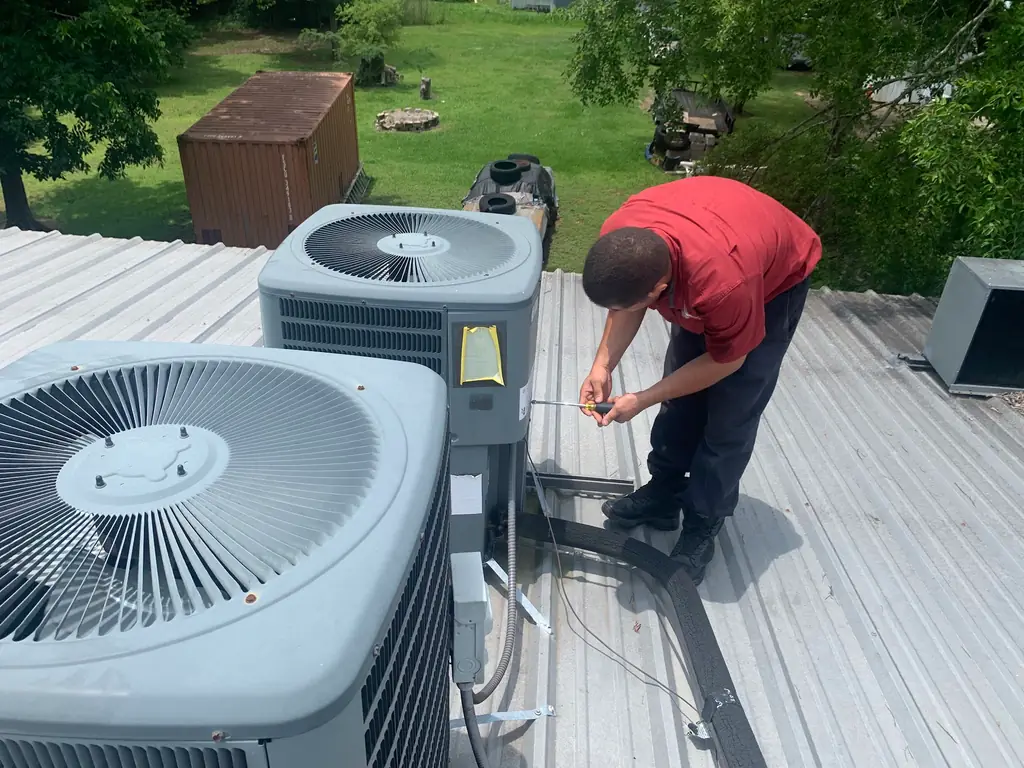
It is one of the most common complaints in two-story homes across Montgomery County, and it has almost nothing to do with the AC system being broken. Downstairs feels perfectly comfortable. Upstairs, especially by evening, feels five or six degrees warmer, sometimes more. The thermostat says the target temperature has been reached. The bedrooms upstairs disagree.
Why heat pools upstairs no matter how good the system is
Warm air rises and cool air sinks, which is true in a house the same way it is true everywhere else. In the afternoon, an upstairs level absorbs direct heat through the roof and attic above it while the ground floor stays shaded and closer to the earth. By the time a single thermostat mounted downstairs reads a comfortable temperature and tells the system to stop, the upstairs level is often still noticeably warmer, because that one thermostat can only ever measure the air around itself. It has no way of knowing what the second floor actually feels like.
What zoning actually does
A zoned system splits the house into separate areas, each with its own thermostat and its own set of motorized dampers inside the ductwork that open and close to direct airflow where it is needed. Instead of one thermostat making one decision for the whole house, each zone calls for cooling independently. Upstairs can keep running while downstairs has already reached its target, or the reverse at night when bedrooms need more cooling than the living areas below them. One system converted to multi-zone control needed four separate thermostats to manage its zones properly, which gives a sense of how granular a well-designed zoning setup can get in a larger home.
Why night and day feel so different upstairs
The upstairs-downstairs gap is not constant through the day, and that pattern itself is a clue. In the afternoon, direct sun on the roof and stored heat in the attic push the upstairs temperature well above the downstairs reading, and a single thermostat downstairs has no way to react to that because it is not measuring it. By late at night, after the roof has cooled and the sun has been gone for hours, that same gap often narrows or even reverses, with bedrooms finally catching up right around the time everyone is trying to fall asleep in a room that spent the whole afternoon absorbing heat it has not fully shed yet. A single thermostat, mounted on a wall downstairs, is structurally incapable of responding to that swing, no matter how well it is calibrated or how new the equipment behind it is.
Zoning is not the only fix, and it is worth ruling out the simpler ones first
Before assuming a full zoning system is the answer, it is worth checking a few simpler things. Attic insulation directly above the second floor matters enormously in a Texas summer. Return air placement matters too; many older two-story homes only have returns on the ground floor, which can starve the upstairs system of the air it needs to circulate properly. Duct sizing to the upstairs rooms, especially rooms at the far end of a long run, can also be the actual bottleneck rather than a lack of zoning. A real evaluation looks at all of this together rather than jumping straight to the most expensive option.
- Check attic insulation levels above the upstairs ceiling.
- Confirm there are adequate return air vents on the upper floor, not just supply vents.
- Have the ductwork feeding upstairs rooms inspected for undersizing or long, restrictive runs.
- Consider a zoned system with separate thermostats if the house is large enough that a single zone genuinely cannot serve it evenly.
None of this needs to be diagnosed from a chair. A real evaluation involves someone walking the attic, checking the ductwork feeding the upstairs rooms, and looking at how the house was built before recommending anything, whether that ends up being a duct fix, an added return, or a genuine zoning system with its own set of dampers and thermostats. Guessing at which one your house needs from the internet is a good way to spend money on the wrong fix, and a bad way to find out your bedroom is still five degrees too warm come August.
David's Same Day Services evaluates two-story comfort problems as a whole system rather than guessing at a single fix, and has installed multi-zone setups in Conroe-area homes where that was genuinely the right answer. Call (713) 589-2104 any hour of the day to have someone take an honest look at your house before spending money on the wrong solution.
David's Same Day Services Inc., (713) 589-2104
Call (713) 589-2104