Why Your AC Picks the Hottest Week of the Year to Quit
It never seems to fail in April. It fails the first week it actually has to work.
August 27, 2026 · 4 min read
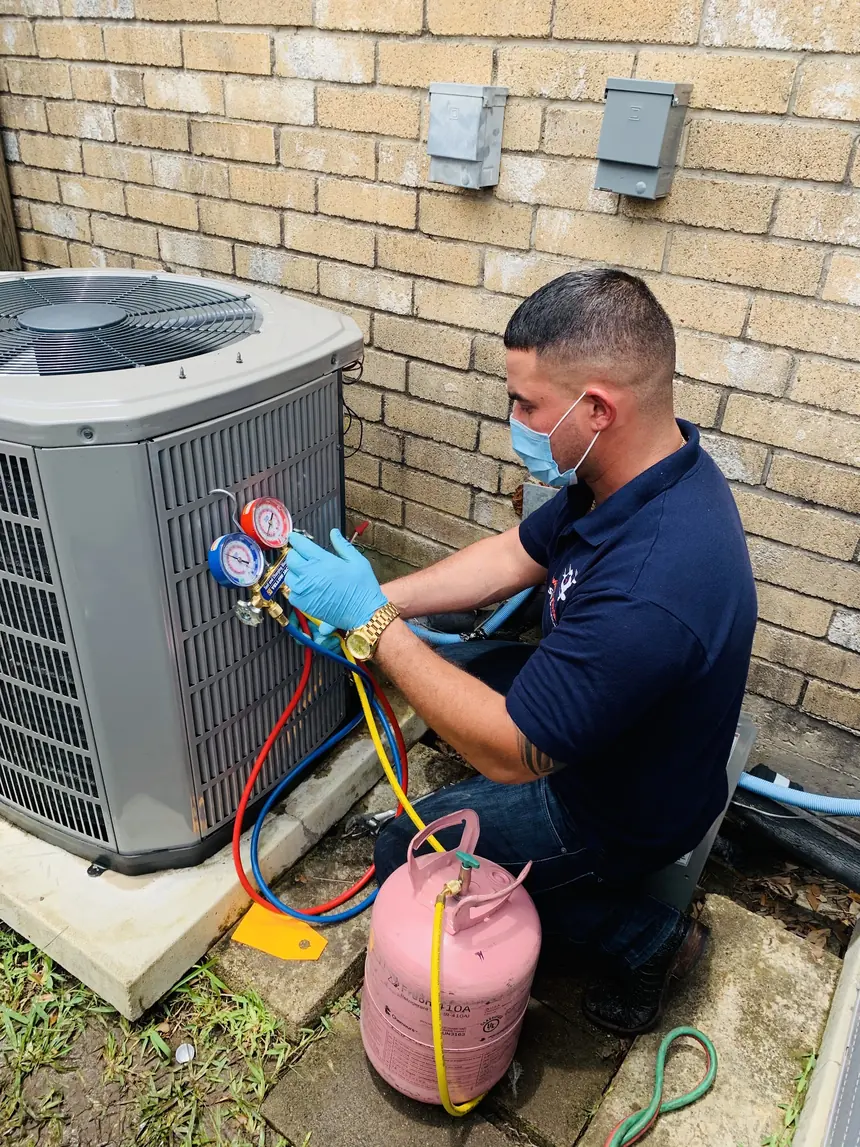
It happens the same way almost every year in Montgomery County. April and May stay mild enough that a tired air conditioner can limp along without anyone noticing anything is wrong. Then the first real stretch of 95-degree days arrives, usually sometime in June, and the phone starts ringing across Conroe with the same story on the other end: the system ran fine all spring, and then it just stopped.
What is actually wearing out
A residential AC system rarely fails because of one dramatic event. Most of the time it fails because a handful of parts have been quietly degrading for months, and the first stretch of sustained heat is what finally pushes them past the point of working. The capacitor that gives the compressor and fan motor their initial jolt of starting torque loses capacitance as it ages. A weak capacitor that could still start a motor through 85-degree days sometimes cannot start it at all once the system has to run for twelve or fourteen hours straight. Contactors, the switches that control power to the outdoor unit, pit and burn a little every time they open and close, and a system cycling constantly in extreme heat puts thousands of extra cycles on that one part in a single week. Refrigerant charge that was a few ounces low back in April, small enough that nobody noticed a couple of lost degrees, becomes obvious in June when the system runs and runs and still cannot keep the house comfortable.
What is worth checking before you call anyone
Some AC failures really are simple, and it costs nothing to rule those out first.
- Check the breaker panel. A tripped breaker on the outdoor unit is common enough that it is always worth a look before anything else.
- Change the air filter if it has been more than a month or two. A clogged filter starves the system of airflow and can shut it down on a safety switch.
- Confirm the thermostat is set to cool with the target temperature below the room temperature, and swap the batteries if the display is dim or blank.
- Walk outside and look at the condenser. Grass clippings, leaves, and dryer vent lint pressed against the coil block airflow and can be enough on their own to cause a struggling unit to quit.
- Listen for anything unusual. A humming outdoor unit that will not start, a sharp clicking sound, or a burning smell all mean it is time to shut the system off at the breaker and call rather than keep trying it.
Why guessing costs more during the first heat wave than any other week
An AC system in Montgomery County during the first real hot stretch of the year is already running close to its limit under normal conditions, and a partial fault rarely stays partial for long once it is pushed that hard. A weak capacitor that is limping a compressor along can burn that compressor out within days if the system keeps trying to start against it. A refrigerant leak that was a slow drip in spring accelerates once the system is running nearly around the clock. What would have been an inexpensive fix in April can turn into a full compressor replacement by the second week of June, and the difference is usually just how long the system kept struggling in a state it was never going to sustain.
The humidity makes it worse, not just the heat
A thermometer reading in the mid-90s does not tell the whole story in this part of Texas. Gulf coast humidity means the system is not only removing heat, it is pulling a large amount of moisture out of the air at the same time, and that second job is what makes an AC system labor so much harder here than it would in a dry climate reading the same temperature. A system that is already marginal on refrigerant charge or airflow shows that weakness first as poor dehumidification, a house that feels clammy even though the thermostat reads the target number, before it shows up as an outright failure to cool. If a house has felt sticky rather than simply warm over the last week or two, that is often the early version of the same failure that finally shows up as a dead system on the first truly hot day.
The week everyone else is calling too
There is a practical reason to call sooner rather than waiting to see if the system recovers on its own. The first sustained heat wave of the season is also the week every other AC company in Montgomery County gets flooded with calls, because every marginal system in the region tends to fail around the same stretch of days. Getting a technician out quickly matters more that week than almost any other time of year, which is exactly why being reachable around the clock rather than during standard business hours makes a real difference to how long a house sits at 85 degrees waiting.
David's Same Day Services is a licensed Texas HVAC contractor, TACLB 00104399, and the crew works 24 hours a day, seven days a week across Conroe and the surrounding Montgomery County communities. If your system stops during the first real heat wave of the year, call (713) 589-2104. A military discount and a guaranteed price match are available, and financing is an option if the visit turns into a bigger repair than you expected.
David's Same Day Services Inc., (713) 589-2104
Call (713) 589-2104More articles
What to Tell Us When You Call for Same-Day AC Service
The faster you can describe the problem, the faster we can solve it.
Repair or Replace: How to Think About an Aging AC System Honestly
The right answer depends on the system's age and its history, not on which repair happens to be in front of you today.