What actually stops cooling in Conroe heat
Most repair calls come down to a short list of parts doing the real work behind the scenes: a capacitor that has weakened, a contactor with pitted contacts, a coil coated in dust and pet hair, or a system that is simply low on charge. Any one of those can show up as the same complaint on the phone, warm air at the vents, a compressor that trips and restarts, or nothing happening at all when the thermostat calls for cooling. We check the whole circuit rather than guessing at the first part we see, because replacing a capacitor on a unit that is actually low on charge just buys you the same service call again in two weeks.
The call that usually ends with a stubborn problem finally fixed
One review on our Google listing describes a main drain line so badly clogged that another company gave up on it. Leon cleared it and got the system back to peak cooling the same visit. A blocked condensate line is one of the most common reasons a system shuts itself off in the middle of a Texas summer, the float switch does exactly what it is built to do and kills the unit before water backs up into the ceiling. It looks like a bigger problem than it is once someone actually traces the line.
Frozen evaporator coils, drain float switches that will not reset, and a compressor that hums but will not start are all things we see on a normal week in Montgomery County, not rare failures.
READ THE SYMPTOMS
Why the same complaint has a few different causes
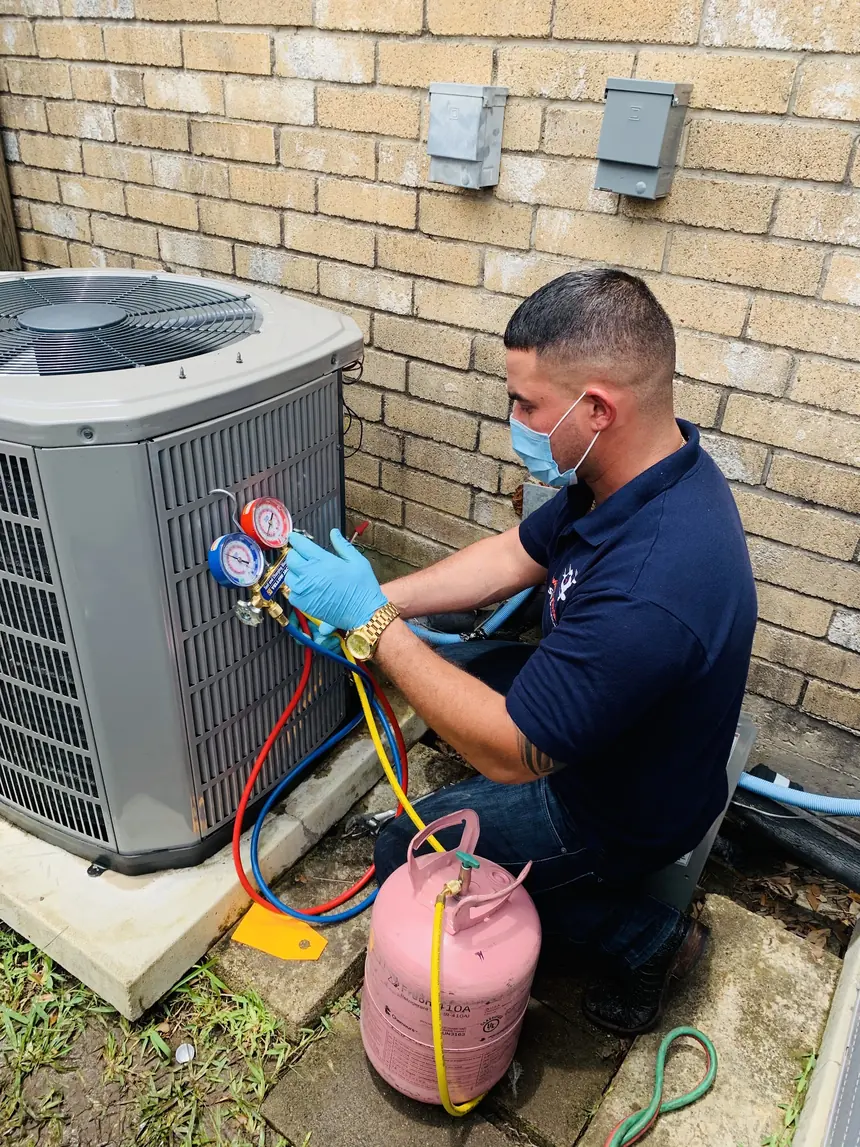
Short cycling, warm air, and a unit that will not start at all sound like three separate problems on the phone, but they often trace back to the same handful of parts. A weak capacitor cannot spin the compressor up, so the unit clicks and stops. A dirty coil cannot shed heat properly, so the system runs long, trips a high-pressure safety, and shuts itself down before it finishes cooling the house. A frozen evaporator coil, usually caused by low airflow or a low charge, will blow room- temperature air even though the outdoor unit sounds like it is working hard. None of these are guesswork on our end. A technician with gauges on the system, checking amp draw at the contactor and pressures at the service valves, can usually name the actual fault in the first fifteen minutes rather than swapping parts until something sticks.
Repair is not always the answer, and we will tell you honestly when it is not. If a system is old enough or damaged enough that another repair is throwing good money after bad, our AC installation and replacement page walks through what a full changeout actually involves. If the same house is also dealing with a furnace that struggles on the handful of genuinely cold nights Texas gets, see heating and furnace repair. Either way, the fastest path to a fix is a call, day or night, or a message through our contact page to get someone out to the house.